
Can a “Learn More” Link Become a Regulatory Risk?

When brands think about cosmetic compliance in the U.S., they usually think about the obvious things first.
The product label.The ingredient list.The claims on the product page.The packaging.
But there is another area that can be surprisingly easy to overlook:
The content you link to.
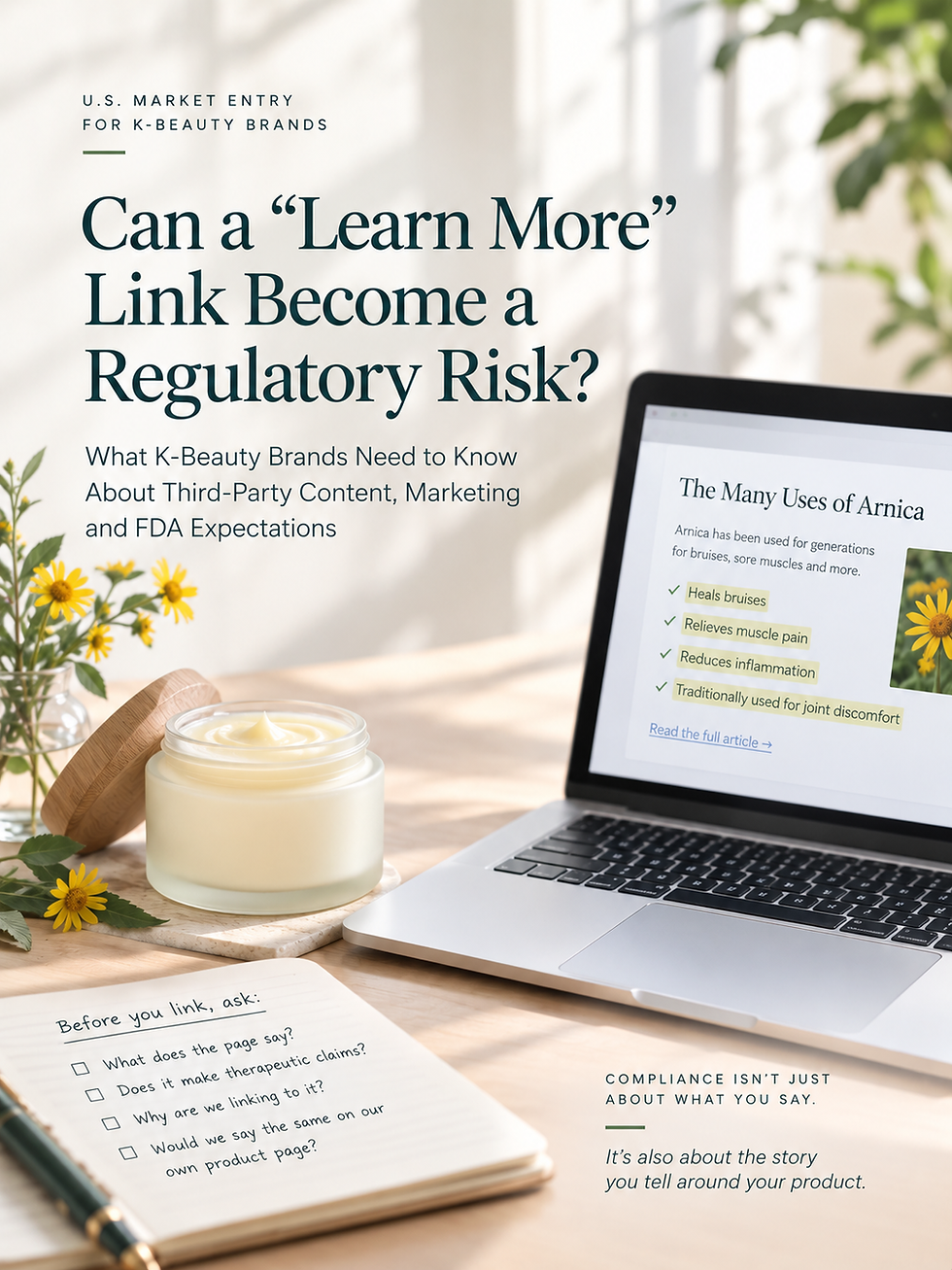
Imagine a brand selling an arnica balm.
The brand itself never says that the product “heals bruises” or “relieves muscle pain.” Instead, its website includes a simple message:
“Want to learn more about arnica? Read this.”
The link takes consumers to an article discussing arnica’s traditional use for bruises and sore muscles.
The brand didn’t write the article.
So does it matter?
It can.
Your Marketing Message Is Bigger Than Your Product Label
In the U.S., whether a product is considered a cosmetic or a drug depends in part on its intended use.
That intended use can be communicated through many forms of marketing—not only the words printed directly on the package.
A product presented for cleansing, moisturizing, beautifying, or improving appearance can generally remain within the cosmetic category.
But claims that a product treats a disease or condition, relieves a symptom, or affects the structure or function of the body can raise drug-claim concerns.
For example:
“Helps moisturize dry skin” → cosmetic positioning
“Heals bruises” → therapeutic claim
“Relieves muscle pain” → symptom-relief claim
“Kills bacteria” → potentially antimicrobial/drug claim
“Treats acne” → disease/condition claim
The important point is that regulators can look at the overall presentation of a product rather than treating every piece of marketing as completely independent.
That means your website, social media, educational content, and other communications can all contribute to how consumers understand what your product is intended to do.
But What If Someone Else Made the Claim?
This is where things get interesting.
A third-party article may be able to discuss an ingredient in ways that a cosmetic brand cannot use to market its own product.
A researcher, blogger, nonprofit, or educational organization may discuss the traditional or scientific uses of an ingredient in a context that is not tied to selling a particular product.
But when a company deliberately directs its customers to that information as part of its own marketing, the context changes.
A recent Tenth Circuit decision, KetoNatural Pet Foods v. Hill’s Pet Nutrition, illustrates this broader principle in the advertising context. The court considered whether third-party scientific and educational content used by a company as part of its promotional efforts could be relevant to a commercial-speech and false-advertising analysis. The case was not a cosmetics or FDA case, but its reasoning is relevant to a broader question for marketers: Can a company simply distance itself from content because the content appears on someone else’s website?
The answer is not necessarily.
That does not mean that every external link on a cosmetic website becomes a product claim.
It means that the purpose, context, and way the content is incorporated into marketing matter.
Why This Matters for K-Beauty Brands
This is particularly relevant for beauty brands entering the U.S. market.
K-Beauty brands often invest heavily in ingredient storytelling.
A brand may create content around:
Centella asiatica
Ginseng
Rice extract
Propolis
Tea tree
Snail mucin
Retinol
Peptides
Fermented ingredients
Ingredient education can be an excellent way to communicate product value.
But there is an important distinction between explaining what an ingredient is and telling consumers what the finished cosmetic product does to treat a condition or symptom.
For example:
Lower-risk educational approach:
“Centella asiatica has a long history of use in traditional skincare.”
versus:
Potentially problematic product positioning:
“Our centella cream heals inflammation and repairs damaged skin.”
The second statement creates a very different impression about the product's intended function.
And the same question should be asked when reviewing third-party content.
If your website says:
“Learn more about why centella reduces inflammation →”
and the linked article contains therapeutic claims, you should consider whether you are effectively using that content to communicate a benefit of your product.
The “Two-Click” Mindset May Not Be Enough
There has sometimes been an informal assumption in digital marketing that if a consumer has to click away from your website to see a claim, the claim somehow belongs entirely to the third party.
The recent Tenth Circuit decision is a useful reminder that courts can take a more holistic view of how companies use third-party content in commercial communications.
Again, this does not create an FDA rule saying that every hyperlink is a drug claim.
But for brands operating in a highly regulated market, it is a good reason to review digital content more carefully.
A Simple Review Before You Hit “Publish”
Before adding an external article, ingredient reference, or educational resource to a product page, ask four questions:
1. What exactly does the linked page say?
Don't only read the headline. Review the full page.
2. Does it contain therapeutic or disease-related claims?
Look for language involving treatment, healing, pain relief, inflammation, disease, antibacterial effects, or changes to body structure or function.
3. Why are we linking to it?
Is it simply educational content about an ingredient?
Or are we using it to support why consumers should buy this particular product?
4. Would we be comfortable putting the same statement on our own product page?
If the answer is no, take another look before making the connection.
A Link Is Not Automatically a Claim
This isn't about avoiding external links.
Brands can—and should—educate consumers.
Ingredient history, manufacturing information, scientific background, sustainability information, and general educational resources can all add value to a brand's communication.
The important distinction is context.
A third-party article existing somewhere on the internet is one thing.
A brand deliberately directing potential customers to that article as part of selling a product is another.
For brands entering the U.S. market, this is an important shift in mindset:
Compliance isn't only about what your product says.
It's also about the story surrounding the product—and how that story is communicated across your entire marketing ecosystem.
A “Learn More” link may be just a link.
But before you click Publish, it's worth asking:
What exactly am I asking my customer to believe about this product?

Your complete K-beauty bridge to the U.S. From manufacturing to FDA compliance,
we provide a seamless, execution-ready system for your brand's global success.
>>>>Click Here and Start Your Own K-Beauty Products Now
Ready to launch in the U.S.? Contact us today.
CONTACT US
Office: 1-909-229-8249
Email: hello@theglowbridge.com


Comments